viernes, 3 de mayo de 2019

ACADEMY FILM SCHOLARS PROGRAM 2019. PROJECT "DONALD TRUMP: ACTOR'S ACTOR. A MARXIST PERSPECTIVE" BY JORGE LUIS VILLACORTA SANTAMATO.

from:sguthrie@oscars.org
to:JORGEVILLACORTA1@gmail.com
cc:grants@oscars.org
date:May 3, 2019, 2:15 PM
subject:Academy Grants Program
security: Standard encryption (TLS) Learn more
:Important according to Google magic.

Dear Jorge:

Recently, the Academy’s Grants Committee met to select the recipients of the 2019 Academy Film Scholars Grants.  Out of 58 applications received, the Committee members were pleased and excited to discover a number of exceptional proposals.  After a great deal of discussion including praise for a number of the proposals, the committee ultimately selected two.  Regrettably, your proposal was not selected.

A press release announcing the two newest Academy Film Scholars will be distributed in the near future and I will make sure a copy is e-mailed to you.

The committee asked me to inform the applicants how much they enjoyed reading the proposals and how worthy many of them seemed.  They anticipate that a number of the proposals will come to fruition.  If you wish to re-apply, the online application form will be available once again in late summer or early fall.

Best of luck in all your future endeavors.

Sincerely,
Shawn Guthrie
Sr. Manager, Grants and Student Academy Awards

-----


Project Statement
By Jorge Villacorta
Donald Trump: Actor's Actor. A Marxist Perspective.
a. Description of the Project.
This is a beautiful and entertaining book that explains why from a Marxist perspective, Donald Trump is an awesome actor.

b. Definitions:
Objective: To explain why from a Marxist perspective Donald Trump is an awesome actor.
Methodology: Observation from a Marxist perspective of those movies where Mr. Trump appears. Description of those appearances in the context of class struggle. Explanation of the social importance of those appearances as an actor from a Marxist perspective.

c. Portions of my project that examine film industry subjects or ideas that have been underrepresented in the canon of film scholarship to date.
Trumpism as well as Marxism and the concept of class struggle are underrepresented in the canon of film scholarship to date. The scholars prefer to take distance from the political position of Donald Trump and due to the fact that mainstream movies are investments, the investors don't want to ptomote the concept of class struggle. My project applies Marxism and class struggle to show what an amazing and tremendous, truly terrific, classy actor Donald Trump is.

c. Academic and Professional Context.
Donald Trump communicates brilliantly with the film audiences and it is important to analyze his style and techniques. The book Reagan: An Icon, by Ewan Morgan, recognized that Mr. Reagan, who used to be an actor, had also great communication skills, but that book isn’t written from a Marxist perspective. In fact, most books on actor or performers turned politicians (Clint Eastwood, Sonny Bono, John Gavin, George Murphy, Jesse Ventura, etc.) don’t deal with the subject from a Marxist perspective. This fact makes my project unique.

e. Significance of the project in its field of study.
Most media scholars aren’t linking the contribution of Mr. Trump’s film appearances to the building of his political image. Mr. Trump’s film image is, precisely, a subliminal construction of this political image. These scholars separate entertainment and politics, but a Marxist perspective considers both of them as diferente aspect of one phenomenon: the class struggle.

f. How my profesional experience is relevant to the project.
As a scholar, researcher, actor, assistant director, editor, media adviser, and curator, I see how different moments of exposure build on an public image. Living in a Third World country increases my political awareness due to the characteristics of the daily local life.

g. Timetable for completing the project.
Date
Activity

May 1, 2019.

I begin to gather information in order to write Donald Trump: Actor’s Actor. A Marxist Perspective.
June 1, 2019.
I begin to write the book.
August 1, 2019.
I finish the first draft of the book.
August 2 – December 24, 2019.
I revise the book and prepare it for printing.
December 25, 2019
The book is printed.

h. Grants, residencies, and additional resources available to me. How I intend to use the Academy grant.
There aren’t additional resources but mine. I intend to use the Academy grant wisely.
-----

Select Bibliography
By Jorge Villacorta
Donald Trump: Actor's Actor. A Marxist Perspective
Alford, Matthew (2010). Reel Power. Hollywod Cinema and America Supremacy. London: Pluto Press.
Blouin, Michael (2016). Magical thinking, fantastic film, and the illusions of neoliberalism. New York: Palgrave Macmillan.
Bongino, Dan (2018). Spygate: The Attempted Sabotage of Donald J. Trump. Nasville, Tenn: Post Hill Press.
Bourdieu, Pierre (1993). The Field of Cultural Production. Cambridge: Columbia University Press.
Bourdieu, Pierre and Susan Emanuel (2006). The Rules of Art: Genesis and Structure of the Literary Field. Stanford, California: Stanford University Press.
Buskirk, Chris and Leibsohn, Seth (2017). How Conservatism, Inc. Missed the 2016 Election & what the D.C. Establishment Needs to Learn. Washington D.C.: WND Books.
García Espinoza, Julio (1983). “For an imperfect cinema” from Twenty-five years of the New Latin American cinema pp 28-33, London BFI.
Gutiérrez Alea, Tomás and Sánchez Oliva, Iralda (1988). The viewer’s dialectic. La Habana: Editorial José Martí.
Hadjinicolaou, Nicos (1978). Art History and Class Struggle.  London: Pluto Press.
Hadjinicolaou, Nicos (1981). La producción artística frente a sus significados. Mexico City: Siglo XXI Editores.
Haiven, Max (2018). Art after money, Money after Art. Creative Strategies Against Financialization. London: Pluto Press.
Hathherley, Owen (2016). The Chaplin Machine: Slapstick, Fordism and the Communist Avant-Garde. London: Pluto Press.
Hauser, Arnold (2016). The Social History of Art: Naturalism, Impressionism, the Film Age. New York, NY: Routledge.
James, David E. and Berg, Rick (1996). The hidden foundation: cinema and the question of class. Minneapolis, Minn: University of Minnesota Press.
Jordan, Chris (2003). Movies and the Reagan Presidency: Success and Ethics. Wesport, Conn: Praeger.
Kornbluh, Anna (May 02, 2019). Marxist Film Theory and Fight Club. Unknown: Bloomsbury Academic.
Leigh, Mary K. and Durand, Kevin K. (2013). Marxism and the Movies. Critical Essays On Class Struggle In The Cinema. North Carolina: McFarland & Company, Inc.
Metzger, Robert P. (1989). Reagan. American icon. Lewisburg, Pa: Bucknell University.
O’Neill, Deirdre (2018).  Film as a radical pedagogic tool. New York: Routledge.
Sayer, Sean (1998). Marxism and human nature. London: Routledge.
Trump, Ivana and Fraser, Alison (2017). Raising Trump. New York, NY: Gallery Books.
Usual Gang Of Idiots (2017). Mad about Trump: a Brilliant Look at Our Brainless President. New York, NY: Mad Publications.
Walker, John A. (2002) Art and celebrity. London: Pluto Press.
Wayne, Mike (2005). Understanding film: Marxist perspectives. London: Pluto Press.
Woods, Allan (2001). Art and Class Struggle. St. Paul, Minn: Wellred.

------

jueves, 25 de abril de 2019

"CHESU MARE: BULLYING DIABÓLICO". PELÍCULA COMPLETA. PROYECCIÓN MUNDIAL.

LA CASA MUSEO LEONIDAS ZEGARRA TIENE EL PRIVILEGIO DE INVITAR A LOS LECTORES DE PERUCINE.BLOGSPOT.COM A LA PROYECCIÓN MUNDIAL DE "CHESU MARE: BULLYING DIABÓLICO", AUTOBIOGRAFÍA FÍLMICA DEL MÁS EXCELSO CINEASTA DEL MUNDO ENTERO: DON LEONIDAS ZEGARRA UCEDA.


Como suele suceder cuando nos interesa algo, hemos terminado por obtnerlo: a partir de ahora, el público mundial, interplanetario e interdimensional, tiene oficialmente a su disposición el largometraje autobiográfico de Don Leonidas Zegarra Uceda.

Esta película se caracteriza a nivel temático por cuestionar las estructuras mentales impuestas en el Perú por los aparatos ideológicos de estado, que han privilegiado una producción ideológica fundamentada en una dieta intelectual compuesta por religión (Católica) y discurso feudal. Como seguimos viviendo en un mar mental parecido al de Florencia hace 700 años, con algunas originalidades, "Chesu mare: Bullying diabólico" se erige como representante de unas concepciones que pertenecen a sectores sociales que logran elevar sus ideales por sobre el horizonte histórico y pensar e imaginar una sociedad regida por sus miembros y no por polarización del ser humano en su actividad e imaginación. 

El lenguaje audiovisual resulta una delicia para los estudiosos de la obra de Leonidas Zegarra.

A nivel emotivo, tenemos que confesar que la película nos ha hecho llorar en el mismo punto al verla tres veces. Al desarrollarse la escena, en la que se canta, inevitablemente ruedan las lagrimitas (ese líquido salado que sale de los ojos), seguramente porque la escena está vinculada al primer día de colegio. Es evidente que los traumas ocasionados por estos campos de concentración pueden perdurar por largos años. Sorprendentemente nadie los llama por su nombre ("campos de concentración") ni se hace referencia a su función ("centro de adoctrinamiento"), sino que se les sigue llamando "colegios", término que ha logrado evadirse de la dimensión política de estos centros de detención de la niñez.

"Chesu mare: Bullying diabólico" es una película épica cuyo complemento ideal es "REST AND MAKE YOURSELF RICH", autobiografía literaria de Leonidas Zegarra del año 1989.

La exhibición mundial de "Chesu mare: Bullying diabólico" (2014) por medio de IMDb.com es un hito histórico que demuestra la superioridad económica del productor, guionista y director Leonidas Zegarra, quien puede poner a disposición del público mundial que tiene a acceso a internet su filme por medio de un precio accesible (nada). Don Leonidas Zegarra Uceda sigue señalando la dirección del cine mundial.

sábado, 20 de abril de 2019

LEONIDAS ZEGARRA / ROBERTO ROSSELLINI. MILAGRO - MILAGRO. "MARÍA Y LOS NIÑOS POBRES" (2010) Y "VIAGGIO IN ITALIA" (1953/1954) [EL VIAJE A ITALIA] [TE QUERRÉ SIEMPRE]


La escena del milagro en "María y los niños pobres" (2010) contextualizada en la historia del estilo cinematográfico remite, entre otros filmes, a "Viaggio en Italia" (1953/1954) dirigida por Roberto Rossellini. Las intenciones de cada director quedan en evidencia cuando las imágenes de ambas películas entran en diálogo. A nivel temático, donde para Rossellini el milagro es la supervivencia del sentimiento frente a la racionalidad, para Leonidas Zegarra el milagro es el sentimiento mismo, intenso y desbocado, puro e iluso, como el de los niños. "Catherine", el personaje de Ingrid Bergman, dice que "los niños son felices" frente a las afirmaciones de su esposo, quien dice ante la religiosidad católica italiana "¿cómo pueden creer en eso? ¡son como un montón de niños!". En la película de Leonidas Zegarra la crítica racional está descartada, por tanto, ambos personajes, la pareja de esposos, está ausente, pero los demás elementos de la religiosidad popular, que Rossellini muestra manteniendo la distancia del punto de vista en planos medios o generales, en un exterior, Leonidas Zegarra los muestra con gestualidad semejante pero en esteroides, exaltada, incrementada, en primeros planos de rostros, manos y grupos de creyentes, un espacio cerrado (el interior de un templo), y expresiones vocales también en primer plano sonoro, a diferencia de "Viaggio in Italia", donde los sonidos producidos por los instrumentos musicales que acompañan la procesión o las conversaciones de los personajes con creencias religiosas no anulan la claridad de la conversación de la pareja. El milagro en la película de Rossellini también implica sobrevivir al torrente emocional. En Leonidas Zegarra, el milagro es perderse en tal torrente y abrazar la irracionalidad emocional con todas las energías de que se dispone. Como es el ritual católico el representado, tienen que existir parecidos en las formas de conducta de los personajes con creencias religiosas, pero Leonidas Zegarra, pese a las características señaladas, tampoco descarta el uso de planos generales tal como lo hace Rossellini. Solamente que, en "Viaggio in Italia", es la interacción de la pareja la privilegiada con los puntos de vista más cercanos (primeros planos), mientras que en "María y los niños pobres" el personaje privilegiado es el colectivo, la unidad de creyentes, que se turnan para particularizar la creencia general, la identidad emocional que los unifica. Tal vez para Rossellini, tal unidad únicamente parece darse por medio de la pareja, en lucha con el propio intelecto. Este no es un problema que inquiete a Leonidas Zegarra, para él emoción irracional arrastra todo su entorno y le permite experimentar su unidad con los demás, hasta el punto íntimo en el cual los considera sus semejantes.
-----

jueves, 11 de abril de 2019

LEONIDAS ZEGARRA / LUIS BUÑUEL - SALVADOR DALÍ. ATROPELLO - ATROPELLO. "MARÍA Y LOS NIÑOS POBRES" (2010) Y "UN CHIEN ANDALOU" (1929) [UN PERRO ANDALUZ].


"MARÍA Y LOS NIÑOS POBRES" (2010)
https://www.imdb.com/title/tt4339972/videoplayer/vi1367128345
Director: Leonidas Zegarra.
https://youtu.be/WkHjp8D2Abs


"A CHIEN ANDALOU" (1929) ["UN PERRO ANDALUZ"]
Director: Luis Buñuel. Guión: Luis Buñuel - Salvador Dalí.
https://youtu.be/o7xTjeLG5SM?t=482


Imagen volteada horizontalmente o como si fuese reflejada en un espejo.
----


---


----
---- 
La maestría cinematográfica de Don Leonidas Zegarra Uceda lo lleva a citar visual y temáticamente obras conocidas de la historia del cine, reformulando los temas e imágenes para adaptarlos a su propia sensibilidad narrativa. Tal es el caso de la referencia a "Un chien andalou" (1929) ["Un perro andaluz", cortometraje dirigido por Luis Buñuel con apoyo en el guión de Salvador Dalí. Don Leonidas Zegarra recrea la escena del atropello en "María y los niños pobres" rediseñando planos de la "Un perro andaluz" para adaptarlos a su propia necesidad. Por ejemplo, el plano en el cual se superpone el auto sobre la figura femenina es la película de Luis Buñuel está situado en un plano general que no permite observar con detalle al personaje. Don Leonidas transforma esa zona de la imagen en un plano medio del personaje y para mantener la figura del automóvil coloca la versión contemporánea del mismo en posición semejante detrás del personaje. 

En "Un perro andaluz" el automóvil que se aproxima a la joven está en un calle donde solamente se ve un auto estacionado apuntando en dirección contraria, como se observa en la toma frontal, mientras que en "María y los niños pobres" la calle está llena de autos que apuntan en la misma dirección que el automóvil protagonista y el personaje comienza a atravesar la calle y se observa esto en el mismo plano (lo cual no ocurre en "Un perro andaluz").  Las líneas de composición de este plano  en "María y los niños pobres" son semejantes a las que se encuentran en el reflejo del plano de "Un perro andaluz", como si al observar el reflejo de la imagen hubiesen ocurrido cambios (aparición de múltiples autos que apuntan en la misma dirección, presencia del personaje).

Adicionalmente, el plano en el cual un personaje masculino es transportado cargado en "Un perro andaluz", es semejante en su composición a un plano en el cual es cargado el personaje atropellado en "María y los niños pobres".
----

viernes, 5 de abril de 2019

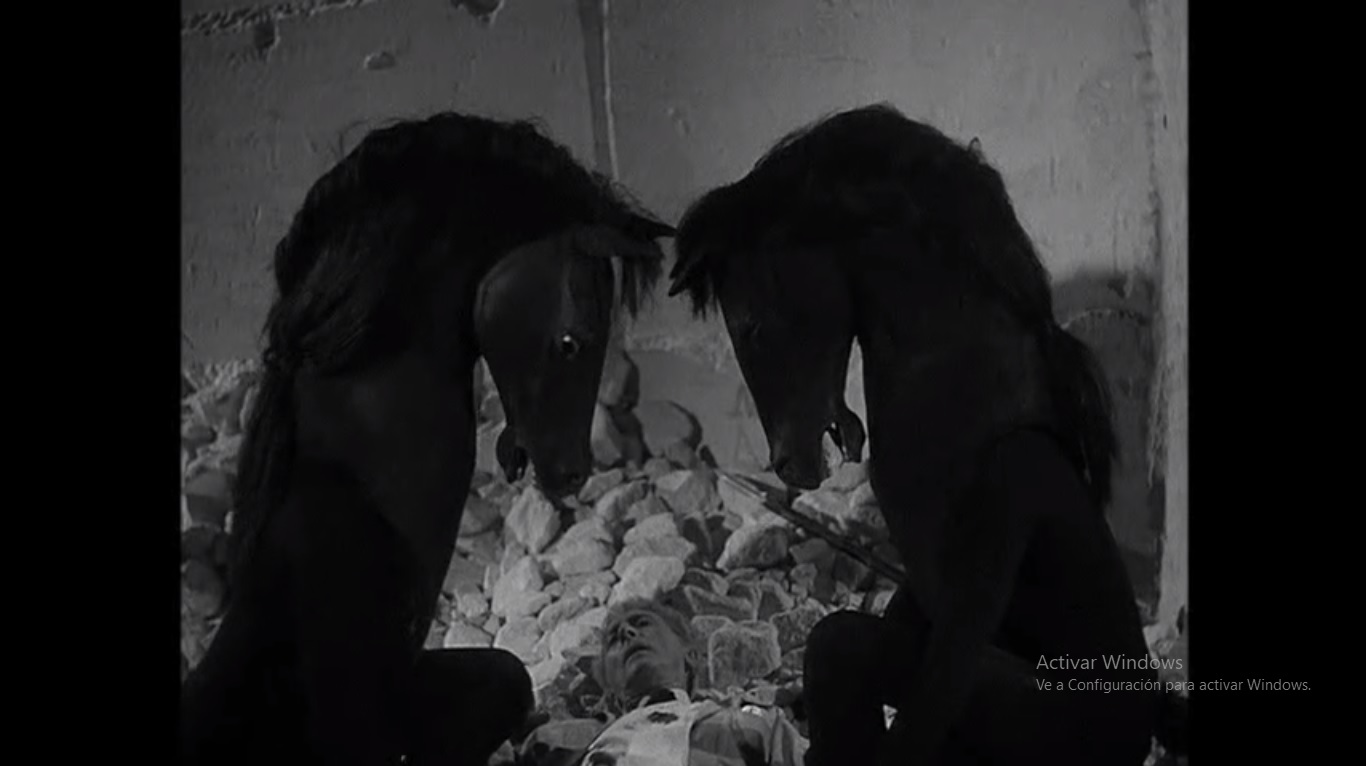
LEONIDAS ZEGARRA / JEAN COCTEAU. CEBRA - CABALLO. "MARÍA Y LOS NIÑOS POBRES" (2010) Y "LE TESTAMENT D'ORPHÉE (1960) [EL TESTAMENTO DE ORFEO] .


"LE TESTAMENT D'ORPHÉE" (1960) ["EL TESTAMENTO DE ORFEO"].
"MARÍA Y LOS NIÑOS POBRES" (2010)
Director: Leonidas Zegarra.

"LE TESTAMENT D'ORPHÉE" (1960) ["EL TESTAMENTO DE ORFEO"¨.
Director: Jean Cocteau.
14:12.

"LE TESTAMENT D'ORPHÉE" (1960) ["EL TESTAMENTO DE ORFEO"].
Director: Jean Cocteau.
1:11:02.

Don Leonidas Zegarra, con la habilidad que lo caracteriza para la observación sardónica y el comentario satírico, cita y rinde homenaje al tercer filme de la "trilogía órfica" de Jean Cocteau, poeta, pintor, novelista, cineasta, etc.

Don Leonidas utiliza una cebra en lugar de un caballo negro. En "Le testament d'Orphée", el poeta se encuentra por primera vez con el caballo en un camino, en un ambiente semirural, sin cruzar palabra con él. La segunda vez ya no puede cruzar palabra con los dos caballos que se le acercan porque ha fallecido. En "María y los niños pobres" la cebra se encuentra con dos niños, que no solamente lo saludan, sino que casi lo obligan a bailar a la ronda con ellos.  Los niños son como el poeta en varios sentidos, aunque bastante menos melancólicos, y la cebra es un personaje alegre, a diferencia de los caballos, que presentan un cariz siniestro y de mal agüero en "Le testament d'Orphée". 

domingo, 31 de marzo de 2019

EMOTION AND CYBERNETICS IN A VIRTUAL WORLD.

THE APP THAT TEACHES SERENITY...

As we have stated before, Perucine.blogspot.com is tasting and testing virtual world technologies that belong to the future of the time frame we are "living" now.

The particular test under development right now demands the understaning of a virtual world that teaches the user how to achieve serenity. This app, based on nerve stimulating implants, artificial intelligence, and visually naturalistic environments (photorealistic Computer Generates Images [CGI].


creates stressful situations that must be faced by the user. The "player" must keep calm at all times and avoid thinking, waiting until the stressful situation disappears. As simple as this might sound, there is a single requirement that make this more challenging:

1) The nerve stimulating implants interact with the artificial intelligence, and the "player" upload information to the artificial intelligence through information collected from the "environment" by the nerve stimulating implants. The CGI changes the appearance of the environment and the "player" to illustrate the interaction and the passing of time: the climate "changes," the people "grow," etc. Therefore, it seems as if there were "logic" in the virtual world, and as if there were "natural laws." As a consequence, the "player" assumes that he is living in a "world" that is "real", that is subjected to social rules and indifferent physical and chemical "laws." Under these circumstances it is a bit complicated to understand that your consciousness is an artificial one and that the situations you are facing are part of a game.

Even though this requirement implies that you are trapped inside a virtual world, the APP provides clues to identify the digital or binary nature of the world you are in. Some of the clues are:

1) Encrypted in the common language. If you read the words with a different pattern, moving the letters around, you can notice that the message has a second layer. If you speak a language different from English, you will notice that translating the word into English and reading it in you language may make more sense.

For example: "Once upon a time...." begins with the word "once" (one time) but in Spanish it means "ELEVEN" (the number 11.)  And in Spanish the English word for the number eleven can be read as "El E VE N" = Él electronic ve en (He electronic watches in.)
Él (in Spanish is the third person pronoum) - 
E (electronic, like in e-mail) -
VE (In Spanish it means both, "go" and "watch" or "see") -
N (In Spanish the sound of "n" means what in English is written as "in".)

Another example: Zero (in English) = 0 = Cero (in Spanish)
In Spanish, "zero" may sound a bit like "serious" (serio), including an "i". In Spanish "serious" is "serio." But, at the same time, "serio" if formed by two syllables: se-rio, which could mean, written like this "se rió" that "he laughed." Or, due to the fact that the vowel "i" in Spanish may sound like the consonant "y", "serio" could be read as "ser yo" (to be me.) Therefore, 0 (zero) could be "serious" and "to be me", which would mean, combining the meanings, "serious" "is me" in English and "serio se rió" (the serious [man/woman] laughed) or "se rió, ser yo" (he/she laughed, he/she is me.) If you have seen the movie "The Man Who Knew Too Much" (1956) you know that the actress Doris Day sings "lo que será, será", which means "what will be, will be." The word "será" (it will be) is similar to "cero" (zero) because the "c" sounds like the "s" in that word in Spanish. So, Doris Day may be singing "what zero, zero", or, "lo que cero, cero" which in both languages, English and Spanish implies that what is nothing, nothing is, or, what is serious, serious is. Additionally, the is a word that means "he will become crazy" (enloquecerá), which sounds like "lo que será" (what will be) with the particle "en" added at the beggining (en-lo-que-ce-rá.) The song sang by Doris Day would mean that "he/she wll become crazy/mad." Do you notice how the computer plays with the possibilities of the written and spoken languages?

2) Encryped in visual metaphors. The virtual enviroment is built with visual metaphors, but you don't know that while you are collecting data at the initial stages of the game. After a time, that can be "several years" you may notice that unusual or irritating situations around you imply something you have been thinking about. The (let's us called it 'quantum') computer that is running the game uses images related to words and the sound of words from different languages. So, unless your vocabulary grows it seems that getting the meaning would be complicated.

For example: "He electronic watches in" is a sentence not that clear. If you speak a language different from English in the virtual world, you know that "watches" resembles "washes." Also, in English, to watch (mirar) is a verb, but a "watch" (reloj) is a thing. The 'quantum' computer may represent "to watch" with a clock, like in the comic book "The Watchmen." There are as many metaphors as you can imagine and the computer uses them all and it seems to create new ones because as "players" we don't know all the dictionaries in "the (virtual) world."

Under this circumstance, how can you notice that you are in a virtual world?
Well, the computer creates events related to what you think (the visual metaphor sometimes is related to being drunk (borracho) because "to drink" (alcohol) and "to think" resemble each other; or the metaphor is related to the words "sink" (lavabo) or sinking (hundimiento) because, at least in Spanish, these words sound like "think".) When you notice that the computer is taking advantage of what you think in order to exert pressure on you, you begin to understand "the game."

If you like movies, you can see it explained in "The Game" (1997): how did CRS (Consumer Recreation Services) designed and executed its gimmick? The explanation is "through a virtual world." The same as strange situations in "Westworld" (TV series) can easily be explained if we notice that everything happens inside a virtual world ruled by Robert Ford's mind.

http://consumerrecreationservices.co.uk/who-we-are/
http://consumerrecreationservices.co.uk/testimonials/
http://consumerrecreationservices.co.uk/games/level-6/

http://ucpgroup.co.uk/

http://jamesbondexperience.com/missions/mission-2/

Why would Forrest Gump be so successful after a time? Because he didn't think or feel so much!
Why would Trinity and Neo fight without facial expressions inside the matrix? Because it is a clue!
Why would Lieutenant Speer (Clint Eastwood) be expressionles while facing several shooters in City Heat (1984)?
All these performances point out the need of being serene in front of stressful situations. The APP Perucine.blogspot.com is testing generates loads of stressful situations that pretend to be undetectable and to follow intrinsec systemic patterns, which is not the case. In fact, being in this virtual world is like being in the cheapest soap opera, if you believe in what surrounds you. If you stay quiet, the situation will solve itself. This is the goal of the game: to attain a permanent state of serenity.
---

miércoles, 27 de marzo de 2019

LEONIDAS ZEGARRA / ALFRED HITCHCOCK. ASESINO - ROJO. "MARÍA Y LOS NIÑOS POBRES" (2010) Y "MARNIE" (1964) ["MARNIE, LA LADRONA"].

"María y los niños pobres" (2010) / "Marnie" (1964) ["Marnie, la ladrona"].
Leonidas Zegarra / Alfred Hitchcock.


"María y los niños pobres" (2010) / "Marnie" (1964) ["Marnie, la ladrona"].
Leonidas Zegarra / Alfred Hitchcock.

 1:09:39.
"María y los niños pobres" (2010). Director: Leonidas Zegarra.
 1:09:46.
"María y los niños pobres" (2010). Director Leonidas Zegarra.
https://youtu.be/WkHjp8D2Abs?t=311

1:10:03.
"María y los niños pobres" (2010). Director: Leonidas Zegarra.
https://youtu.be/WkHjp8D2Abs?t=331

 1:37:42.
"Marnie" (1964) ["Marnie, la ladrona"]. Director: Alfred Hitchcock.

2:04:53.
"Marnie" (1964) ["Marnie, la ladrona"]. Director: Alfred Hitchcock.

La tonalidad roja es utilizada en "Marnie" (1964) para hacer referencia los estados de angustia intensa que experimenta la protagonista, 'Marnie' (representada por 'Tippi' Hedren). En "María y los niños pobres" (2010) la tonalidad roja es utilizada para expresar la rabia que invade a los personajes. En "Marnie" existe solamente un plano muy breve en el cual Mark Rutland (representado por Sean Connery) señala colocando la mano cerca a la cámara. Es un plano sencillo de reconocer y recordar por la función que cumple. Al estar acompañado de la palabra "rojo", el gesto de Mark Rutland desencadena la angustia de "Marnie" y avasalla su resistencia psicológica. En "María y los niños pobres" la cólera se produce primero en un personaje masculino, un adulto, y en un niño, quienes han contemplado que se atropelló a una niña. Ambos se expresan exaltadamente. Luego, de varios planos, el adulto realizará el mismo gesto que Mark Rutland para señalar al conductor responsable del atropello, mientras repite "asesino, asesino", intentando someterlo psicológicamente. Leonidas Zegarra no aplica la tonalidad roja a una mujer, como Alfred Hitchcock, sino a un varón adulto y a un niño. Y mientras en el filme de Hitchcock el gesto y lo que dice el personaje masculino desencadena un estado de angustia en una mujer, en el filme de Don Leonidas es la exaltación o indignación de un varón adulto lo que lo lleva a acusar y señalar al conductor participante en el atropello, otro varón adulto, el cual también experimenta angustia de modo evidente, pero al que no se le aplica la tonalidad roja. Don Leonidas Zegarra se apropia de las tonalidades rojas de "Marnie" con una un significado distinto y también asimila a su narración uno de los planos más distintivos de "Marnie". Como en "María y los niños pobres" es un mismo personaje al que recibe la tonalidad roja y señala con la mano cerca de la cámara, se facilita establecer la relación con los recursos visuales de "Marnie". Cuando menos, para los interesados en la historia del estilo cinematográfico, se hacen evidentes los jugueteos que realiza don Leonidas con los materiales de filmes precedentes realizados por otros cineastas.

En "Marnie" la tonalidad roja es pulsante, y aparece y desaparece. En "María y los niños pobres" la tonalidad roja permanece estable durante el estado más exaltado de los protagonistas, inmediatamente después de la tragedia, luego desaparece, aún cuando se encuentren exaltados.

---